By Holly Wright
The 2026 Formula 1 season continues this weekend, with Singapore playing host to the final Sprint of the year. Against the spectacular backdrop of the Marina Bay skyline, the championship returns to one of its most distinctive venues, where tight street-circuit racing and the demands of competing beneath the floodlights have created countless memorable moments.
However, the Singapore Grand Prix’s history stretches back much further than its modern association with Formula 1. Long before the first cars raced through Marina Bay at night, Singapore had established its own motorsport tradition on public roads, laying the foundations for an event that would eventually become one of the most recognisable fixtures on the international racing calendar.
From its beginnings in the early 1960s to the introduction of the world’s first Formula 1 night race in 2008, the Singapore Grand Prix has undergone a remarkable transformation. Its story includes championship-defining performances, unexpected victories and controversies that have left a lasting mark on the sport.
The Early Years: Singapore’s Motorsport Origins
Singapore’s relationship with Grand Prix racing began in 1961, when the first event took place on Upper Thomson Road. Originally organised to attract visitors and promote tourism, the race quickly became an important fixture in Southeast Asian motorsport.
The circuit used public roads rather than a purpose-built racing facility, featuring challenging bends and limited room for error. Sections known as ‘Snakes’ and ‘Devil’s Bend’ became notorious for testing drivers’ precision and bravery.
The event was known as the Malaysia Grand Prix between 1962 and 1965 before returning to the Singapore Grand Prix name in 1966, following Singapore’s independence.
However, racing on public roads carried considerable risks. Concerns over safety, combined with the disruption caused by closing roads to traffic, contributed to the event’s eventual cancellation. The final race at Thomson Road took place in 1973, bringing an end to Singapore’s original Grand Prix era.
For more than three decades, the country remained absent from the Formula 1 World Championship calendar. Its eventual return would require a fresh approach to circuit design, safety and the presentation of motorsport to an international audience.
2008: The Arrival Of Formula 1’s First Night Race
Singapore returned to the international motorsport spotlight in 2008, when the Marina Bay Street Circuit hosted its first Formula 1 World Championship race.
The circuit incorporated public roads around the city’s waterfront, placing Formula 1 cars against the backdrop of Singapore’s striking skyline. However, the biggest innovation was the decision to hold the race at night.
Although Formula 1 had previously staged races during the late afternoon and around sunset, Singapore became the first venue to host a Grand Prix under a fully floodlit circuit.
The concept offered a spectacular visual experience while allowing European audiences to watch at a more convenient time. Nevertheless, questions were raised about visibility, the possibility of glare in wet conditions and whether the lighting could provide consistent illumination throughout the circuit.
Extensive testing and approval by the FIA helped address these concerns. The lighting system was designed to provide consistent visibility, with an average intensity of approximately 3,000 lux, according to the figures supplied for the event.
The result transformed Singapore into one of Formula 1’s most distinctive destinations. However, the inaugural race would also produce one of the sport’s most infamous controversies.
Crashgate: The Controversy That Rocked Formula 1
Fernando Alonso won the inaugural Singapore Grand Prix after starting 15th on the grid for Renault. His victory was shaped by a safety car period triggered when team-mate Nelson Piquet Jr crashed into the barriers.
Alonso had already completed his pit stop before the incident, placing him in a favourable position when the rest of the field entered the pits. Meanwhile, Ferrari’s Felipe Massa suffered a disastrous stop after leaving his pit box with the fuel hose still attached.
Initially, Alonso’s victory appeared to be an impressive strategic achievement. However, an investigation in 2009 established that Renault had conspired to cause a deliberate crash during the race to improve Alonso’s chances of winning.
The scandal became known as ‘Crashgate’ and resulted in disciplinary action against senior figures within the team. It also raised serious questions about sporting integrity and overshadowed Singapore’s historic debut.
Despite the controversy, the night-race concept proved successful, and Marina Bay remained an important fixture on the Formula 1 calendar.
What Makes Marina Bay So Difficult To Drive?
Singapore’s appeal extends beyond its appearance. Marina Bay is one of the most physically demanding circuits on the calendar, requiring drivers to maintain concentration throughout a long race in hot and humid conditions.
Ahead of the 2023 Grand Prix, changes to the layout reduced the number of corners from 23 to 19, creating a longer straight. Nevertheless, the circuit remains tight and unforgiving, with close barriers and a bumpy surface leaving little room for mistakes.
Former Renault driver Jolyon Palmer has highlighted the challenge, describing Marina Bay as “a long, complex circuit, and draining as well – a little bit like Monaco – with plenty of bumps.”
The low-speed corners require precise turn-in and careful management of rear-end stability. Drivers must also monitor tyre temperatures, particularly towards the end of the lap, when repeated acceleration out of slow corners can cause the rear tyres to overheat.
Braking zones provide further challenges, while the circuit’s narrow layout can make overtaking difficult. Qualifying performance, pit-stop strategy and tyre management therefore become crucial.
The physical demands are equally significant. Palmer explained that drivers can lose several kilograms of fluid during the race, making hydration essential in Singapore’s humid conditions.
The circuit’s reputation for safety car interruptions is another defining feature. Every Singapore Grand Prix from 2008 through 2023 featured at least one safety car appearance. That run ended in 2024, when Lando Norris won despite grazing the barriers on several occasions.
Sebastian Vettel’s Singapore Success
Few drivers have enjoyed as much success at Marina Bay as Sebastian Vettel. The four-time World Champion won the Singapore Grand Prix five times, taking victories in 2011, 2012, 2013, 2015 and 2019.
His success was built on qualifying pace, consistency and the ability to manage the circuit’s demanding conditions. His 2013 victory was particularly dominant, coming during a season in which he secured his fourth consecutive World Championship.
Singapore also played an important role in his 2012 title challenge. Vettel’s victory helped him close the gap to championship leader Fernando Alonso before eventually claiming the championship later that year.
His connection with the event extended beyond racing. Vettel regularly used Singapore to showcase special-edition helmet designs, including a distinctive 2012 creation featuring flashing LEDs representing constellations associated with family members and loved ones.
The night-time setting has continued to inspire drivers, with Lewis Hamilton and George Russell among those who have introduced distinctive helmet designs for the event. Teams have also embraced special liveries, including Racing Bulls’ denim-inspired design in 2024 and Audi’s Singapore-specific livery for 2026.
Memorable Moments: Hamilton And Sainz
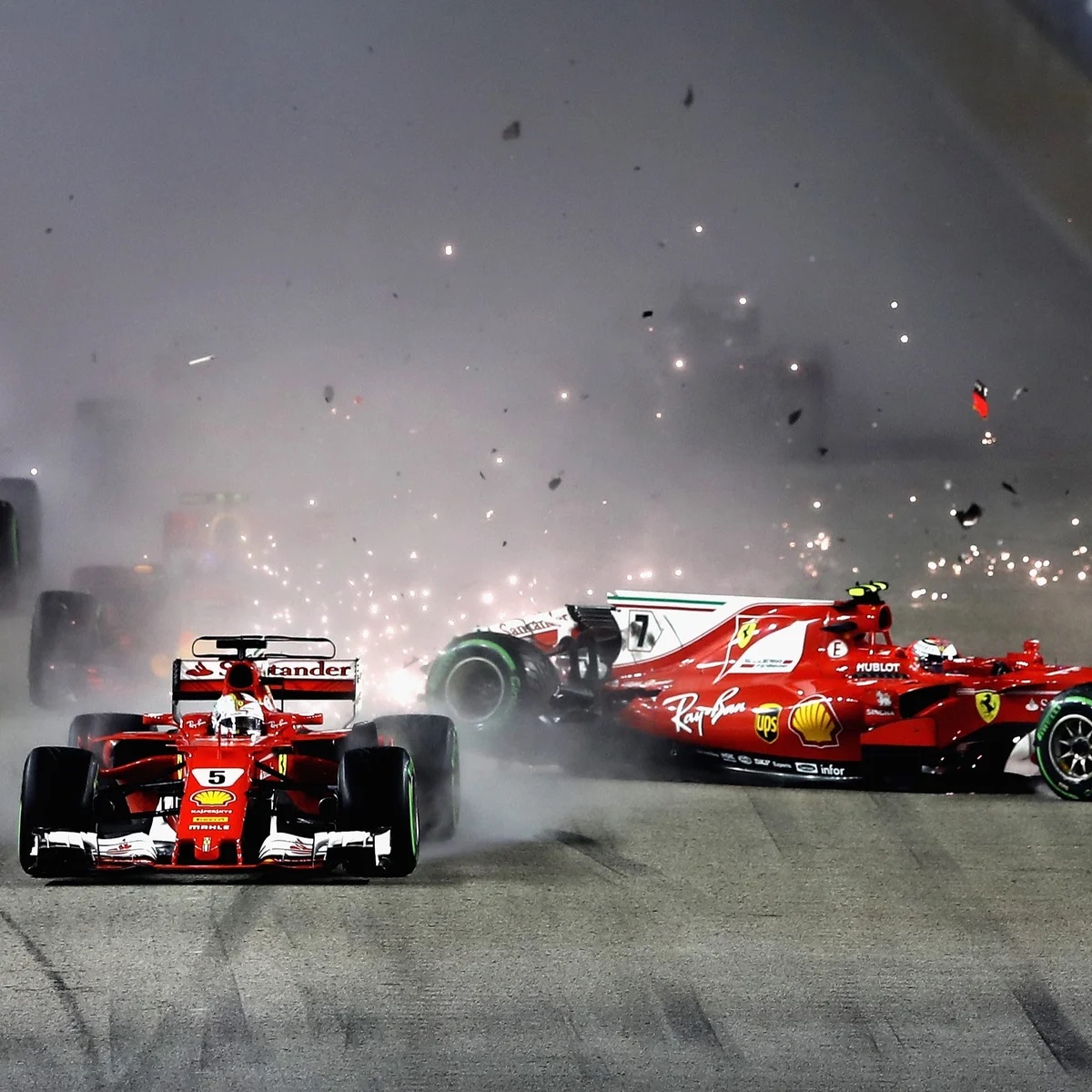
The 2017 Singapore Grand Prix produced one of the most dramatic opening laps in the event’s history.
Rain before the start created difficult conditions, and a collision involving Sebastian Vettel, Kimi Räikkönen and Max Verstappen eliminated all three drivers.
Hamilton, who had started fifth for Mercedes, avoided the incident and inherited the lead. He went on to win, extending his championship advantage over Vettel from three points to 28.
The result demonstrated how quickly fortunes could change at Marina Bay, where avoiding trouble can prove just as important as outright pace.
Another defining moment arrived in 2023, when Carlos Sainz won for Ferrari and ended Red Bull’s run of 10 consecutive victories by Max Verstappen. Sainz became the only driver outside Red Bull to win a Grand Prix that season.
The closing stages produced a tense battle after Mercedes drivers George Russell and Hamilton pitted for fresh tyres. Sainz cleverly kept McLaren’s Lando Norris within DRS range, helping Norris defend against the faster Mercedes pair.
Russell eventually crashed out on the final lap, while Hamilton finished third. Sainz held on to secure a memorable victory, demonstrating how strategy and pressure can combine to produce unexpected results in Singapore.
Fireworks, Music And The Singapore Spectacle
The Singapore Grand Prix has developed an identity that extends well beyond the racing itself. Fireworks illuminating the skyline as the winner crosses the finish line have become one of the event’s most recognisable traditions, providing a spectacular backdrop to the celebrations.
The displays, launched both trackside and over the water around Marina Bay, contribute to an atmosphere that distinguishes Singapore from many other venues.
Live music has become equally important. Over the years, artists including Rihanna, Katy Perry, Shakira, Dua Lipa, OneRepublic, Post Malone and Maroon 5 have performed during the race weekend, helping attract audiences beyond traditional motorsport fans.
The 2026 programme continues that approach, with The Killers, Goo Goo Dolls, Zara Larsson, Lana Del Rey, Janet Jackson and Mark Ronson among the acts scheduled to perform.
Combined with special-edition helmets and team liveries, the entertainment has helped transform Singapore into a major international event. The Grand Prix is no longer simply a race; it is a weekend that brings together sport, music and the wider spectacle of Formula 1.
The Singapore Grand Prix’s Lasting Legacy
More than six decades after the original race on Upper Thomson Road, Singapore’s Grand Prix has undergone a remarkable transformation.
The original event established the country’s motorsport heritage, while the arrival of Formula 1 at Marina Bay in 2008 introduced a new era of night racing. Since then, the circuit has delivered championship-defining performances, unexpected victories and controversies that have become part of Formula 1 history.
Its demanding layout continues to test the drivers, while the floodlights, fireworks, music and distinctive city backdrop have made it one of the championship’s most recognisable destinations.
As Formula 1 returns to Marina Bay in 2026 for its first Sprint weekend at the circuit, Singapore enters another chapter in its history.
From the dangers of Thomson Road to the illuminated streets of Marina Bay, the Singapore Grand Prix is a story of reinvention. Its lasting appeal lies in the combination of sporting challenge and spectacle, creating an event whose identity is instantly recognisable around the world.

