By Joe Murphy
The history of Formula 1 in Malaysia is longer than most fans realise, but its world championship chapter is centred on one circuit.
The name Malaysian Grand Prix dates back to 1962, when it was run at Thomson Road in Singapore while Singapore was still part of the Malaysian federation. After separation in 1965 that race became the Singapore Grand Prix and continued until 1973. On the mainland, the Shah Alam circuit then hosted the Malaysian Grand Prix between 1968 and 1995 for categories including Formula Libre, Tasman Formula, Formula Atlantic, Formula Two and Formula Pacific.
The modern Formula 1 story starts with Sepang. Built on a former oil palm plantation 45 kilometres south of Kuala Lumpur and right next to KLIA airport, the Sepang International Circuit was the first track designed from scratch by Hermann Tilke. It was built in 14 months, nine million cubic metres of earth were moved, and 5,000 palm trees were planted to keep the landscape. It opened in 1999 and immediately became the template for F1’s expansion into Asia.
Sepang held its first world championship Grand Prix in October 1999 as the penultimate round. It is remembered for Michael Schumacher returning just months after breaking his leg at Silverstone to help team-mate Eddie Irvine win for Ferrari, a result that kept the title fight alive. From 2000 the race became the season finale, then from 2001 it moved to an early-season slot in March or April, where the heat and humidity and the late-afternoon thunderstorms became its trademark. At 5.543 kilometres with two long straights and a mix of fast sweeping corners and tight hairpins, drivers loved it for being technical and punishing on tyres and engines.
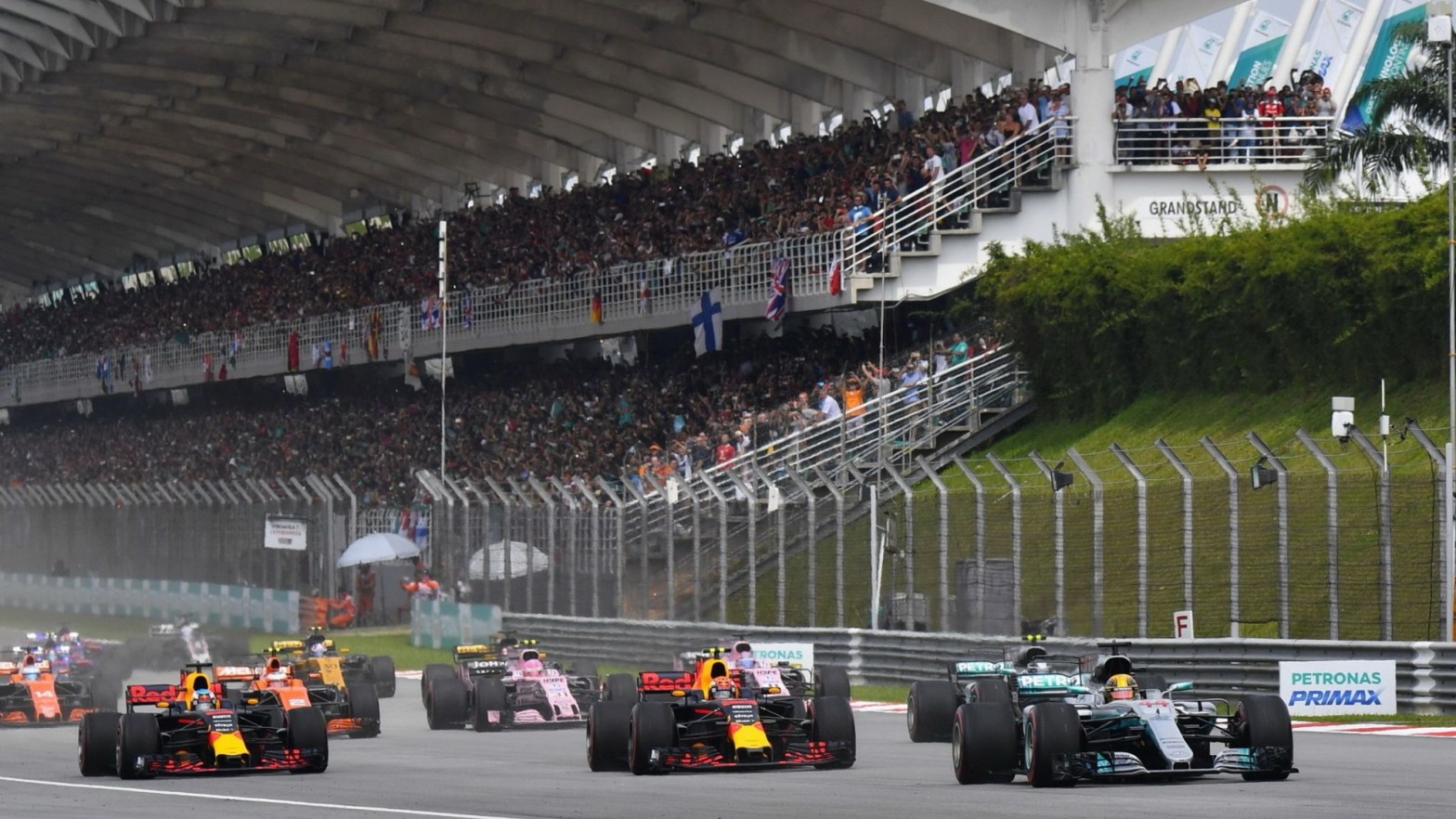
Over 19 consecutive seasons from 1999 to 2017 it produced a string of defining moments. Michael Schumacher won in 2000, 2001 and 2004. Kimi Raikkonen took his first ever F1 victory there in 2003 for McLaren. In 2009 the race was stopped early in torrential rain and Jenson Button was awarded half points for Brawn. 2012 saw Sergio Perez push Fernando Alonso for the win in the wet for Sauber. 2013 produced the infamous Multi-21 controversy when Sebastian Vettel ignored team orders to pass Mark Webber. Vettel is the most successful driver at Sepang with four wins, in 2010, 2011, 2013 and 2015, the last being Ferrari’s first win in more than a year. 2016 is remembered for Lewis Hamilton retiring from the lead with an engine failure which swung the championship to Nico Rosberg, while Daniel Ricciardo led Max Verstappen home for Red Bull’s first one-two since 2013. The final Malaysian Grand Prix in 2017, on 1 October, was won by a 20-year-old Verstappen ahead of Hamilton and Ricciardo.
The race left the calendar after 2017 because the economics no longer worked. The hosting fee had risen to around RM300 million a year, attendance had fallen from a peak of over 120,000 to around 45,000 on race day, and the government concluded that returns were diminishing after 19 years. The circuit stayed active with MotoGP, Asian Le Mans and GT racing.
Formula 1 has now come full circle. This weekend, 2 to 4 October 2026, Sepang is hosting Formula 1 again, but as the Gulf Air Bahrain Grand Prix in Malaysia for some reason. The Bahrain race was cancelled in April due to the regional conflict, and in July F1 announced Sepang would take its slot as round 16 in a triple-header between Azerbaijan and Singapore. The only reason you can think is that Bahrain is paying the hosting fee, hence retaining ticket revenue and naming rights while Malaysia benefits from the subsequent tourism spend. It is a one-off arrangement, with the race due to return to Sakhir in 2027, but for many it is a homecoming for a circuit that pioneered F1’s move east.

