By Joe Murphy
George Russell converted pole position into victory as Max Verstappen fell just 0.196 seconds short. Isack Hadjar completes a rare Red Bull double podium whilst six drivers retire in a chaotic 51-lap contest.
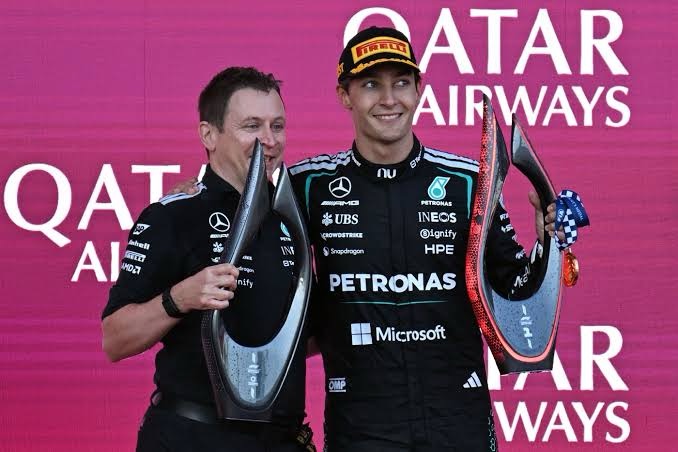
George Russell secured his third victory of the 2026 Formula One season after holding off a determined Max Verstappen in a dramatic Azerbaijan Grand Prix, with the Mercedes driver winning by just 0.196 seconds following a tense battle on the streets of Baku.
What initially appeared to be a straightforward afternoon for Russell developed into a fiercely contested finish after two Safety Car periods brought Verstappen back into contention. The Dutchman applied sustained pressure during the closing laps, but Russell maintained his composure to secure the chequered flag after 51 laps in a race that also featured multiple collisions, six retirements and a valuable podium for Isack Hadjar.
The victory marked Russell’s first Grand Prix win since Austria and strengthened Mercedes’ position in a championship battle increasingly shaped by consistency, strategy and the ability to capitalise on opportunities.
Russell’s afternoon began with the advantage of clean air and a strong launch from pole position. The Mercedes driver immediately established control, opening a gap over Oscar Piastri while Red Bull’s Verstappen and Hadjar worked their way through the leading group.
Russell had qualified with a lap of 1:42.526, securing pole by 0.837 seconds over Charles Leclerc. It was a substantial margin at a circuit where confidence under braking and precision through the narrow castle section are essential.
Verstappen, meanwhile, had started eighth after encountering an engine issue during qualifying. His progress through the field was measured rather than reckless, allowing him to position himself for a late challenge.
The first Safety Car period followed Alex Albon’s accident on lap 29. The neutralisation offered the leading drivers an opportunity to pit for fresh tyres, bringing the field closer together and removing much of Russell’s advantage.
A second Safety Car followed a collision involving Franco Colapinto, Pierre Gasly and Lando Norris. The incident dramatically altered the race, eliminating three drivers and leaving Verstappen in position to challenge Russell directly.
With the field released once more, the contest became a test of precision and nerve. Russell defended his position while Verstappen remained close enough to capitalise on any mistake.
Speaking after the race, Russell acknowledged that his comfortable opening stint had given way to an increasingly demanding finish.
“The first half of the race felt pretty plain sailing, getting the gap,” Russell explained. “Safety Car restart, especially when I saw Max behind, I thought, you know, it’s not going to be easy.”
The decisive moment came on the final lap, when a yellow flag prompted Russell to lift off the power. As he accelerated again, the Mercedes driver experienced a loss of turbo power, allowing Verstappen to close rapidly.
Russell continued: “He drove incredibly at the end of the race. And then when the yellow flag came out, I lifted off the power and when I went back, I had no turbo, so then I had no power. Max almost got me at the line.”
The victory was particularly significant after a challenging period earlier in the season. Russell credited his team for maintaining its support while he adapted his driving style to the demands of the current generation of cars.
“It’s amazing to be back on the top step of the podium,” he said, thanking his engineers for helping him through a difficult spell.
For Verstappen, second place represented a substantial recovery from eighth on the grid, although the Red Bull driver was left to reflect on how close he had come to victory.
His strategy allowed him to progress through the field before the Safety Car periods provided the opportunity to mount a direct challenge. With the soft tyres performing well during the closing stages, Verstappen maintained pressure on Russell without committing to a move that might have compromised his own race.
Verstappen described the final stint as enjoyable, noting that tyre degradation had remained low enough for both drivers to push towards the limit.
Explaining the finish, he said: “On the final lap, with the yellow flag, I think George lost a bit of boost out of one corner and that’s why I caught up quite a bit and then to the line, I got close, but it was not enough.”
The result gave Verstappen 18 championship points, while Russell collected the maximum 25 available for the victory. The narrow margin also demonstrated how quickly a seemingly comfortable lead can disappear around Baku’s unforgiving streets.
Isack Hadjar claimed third, 10.704 seconds behind Russell, completing an aforementioned double podium for Red Bull alongside Verstappen giving him his time in the spotlight after his Monaco podium was somewhat overshadowed by post match discredit and reinstatement.
His performance was particularly notable given his return after six weeks away from racing because of a wrist injury. Rather than attempting to force immediate progress, Hadjar approached the weekend cautiously and gradually built confidence around the demanding circuit.
Hadjar said: “I felt strong and, you know, this weekend I really took it step by step. It’s a track you can end up in the wall really quickly.”
The Frenchman ultimately secured 15 points, adding an important result to Red Bull’s campaign. His podium also demonstrated the team’s ability to convert a competitive car into a substantial points haul despite the pressure created by the Safety Cars and incidents elsewhere in the field.
Charles Leclerc finished fourth for Ferrari in 1:38:16.279, approximately 14.136 seconds behind Russell. Kimi Antonelli secured fifth for Mercedes, recovering from a qualifying crash that had left him starting 16th.
Antonelli’s recovery was one of the quieter stories of the afternoon. Although he did not reach the podium, he limited the damage to his championship campaign by working his way into the points and finishing ahead of Ferrari’s Lewis Hamilton.
Hamilton finished sixth, 22.382 seconds behind the winner. Arvid Lindblad took seventh for Racing Bulls, while Esteban Ocon and Oliver Bearman secured eighth and ninth respectively for Haas. Carlos Sainz completed the top ten for Williams.
For Haas, having both cars inside the points represented a useful result in a race where avoiding trouble proved almost as important as outright pace.
McLaren endured a difficult conclusion to a race that had initially promised considerably more.
Oscar Piastri spent much of the afternoon fighting near the front, but a lock-up at Turn 1 following the second restart caused him to lose substantial ground. He eventually finished 14th, outside the points.
Lando Norris retired after becoming involved in the collision triggered by Colapinto, who locked up under braking and struck Alpine team-mate Gasly. All three drivers were forced out of the race.
The incident prompted a second Safety Car period and removed several competitors from contention. It also left McLaren without a points finish from either car, underlining how quickly a race can unravel on a street circuit where the margin for error is minimal.
Final top ten:
- George Russell – Mercedes – 25 points
- Max Verstappen – Red Bull – 18 points
- Isack Hadjar – Red Bull – 15 points
- Charles Leclerc – Ferrari – 12 points
- Kimi Antonelli – Mercedes – 10 points
- Lewis Hamilton – Ferrari – 8 points
- Arvid Lindblad – Racing Bulls – 6 points
- Esteban Ocon – Haas – 4 points
- Oliver Bearman – Haas – 2 points
- Carlos Sainz – Williams – 1 point
Source: Official Formula One race classification.
Russell’s victory adds another significant result to his 2026 campaign, while Antonelli’s fifth-place finish helps preserve his position in the championship battle.
The Mercedes team now has further evidence that its car can deliver at circuits where straight-line efficiency, braking stability and confidence under pressure are crucial. Russell’s ability to maintain the lead during two Safety Car restarts was central to the outcome, particularly against a driver as experienced as Verstappen.
Red Bull will take encouragement from its double podium, while Ferrari’s fourth and sixth places provide a solid points return without delivering a direct challenge for victory. McLaren, meanwhile, will need to examine the circumstances surrounding its double points-less finish after Piastri’s error and Norris’s retirement.
The wider implications will become clearer over the coming rounds, but Baku has already demonstrated the importance of qualifying position, tyre management and composure during Safety Car restarts.
Russell’s pole-to-victory performance was nearly undone by Verstappen’s relentless closing attack, with the final margin of 0.196 seconds providing a fitting conclusion to a race that had repeatedly threatened to change direction.
For George in particular, the result was a reward for a weekend in which he combined qualifying speed with the ability to defend under pressure. For Verstappen, second place was a reminder that even a recovery from eighth can fall just short when the leader makes few mistakes. Hadjar’s podium added another major talking point, while the incidents involving McLaren, Alpine and Williams demonstrated the unforgiving nature of Baku.

