By Holly Wright
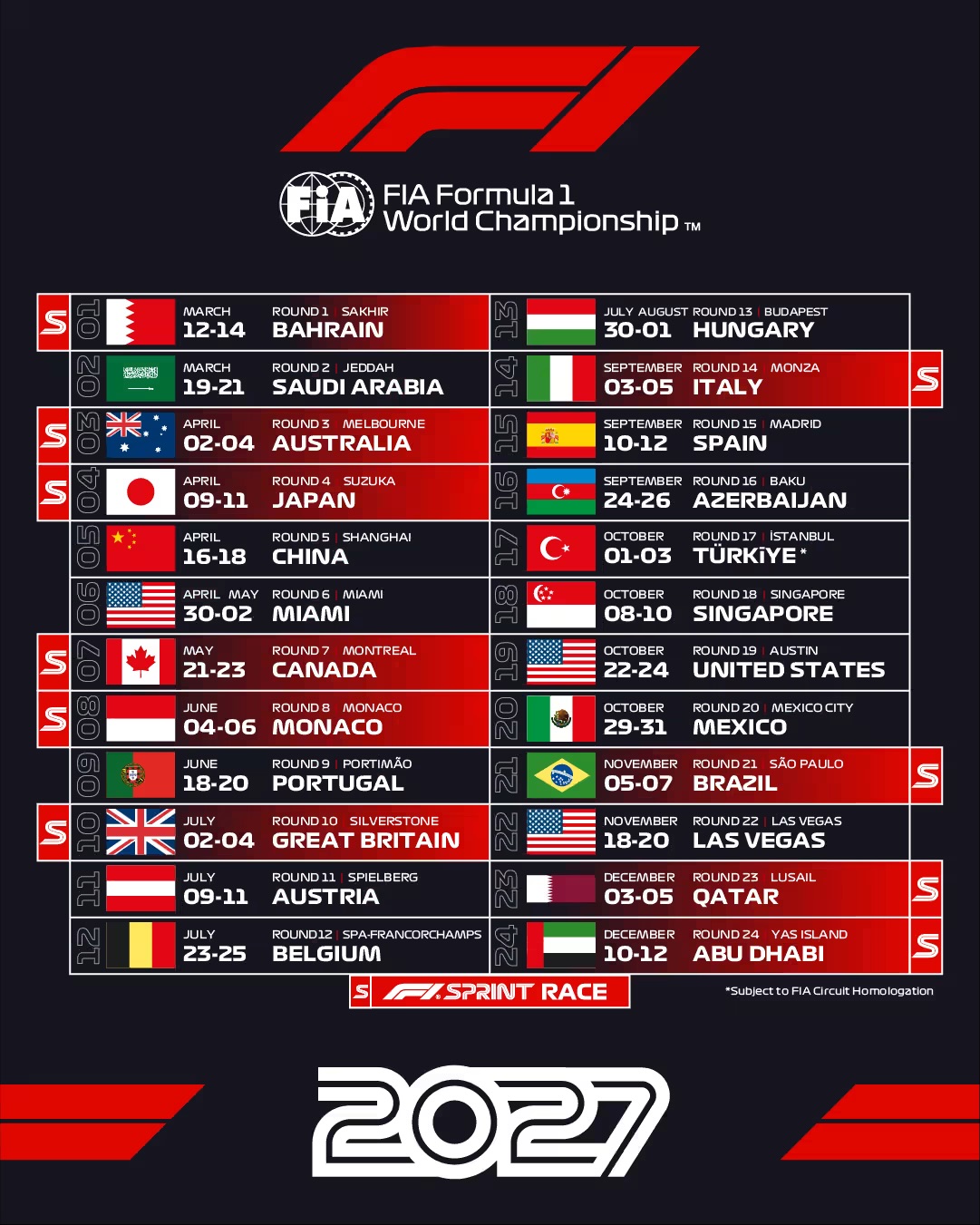
Formula 1’s 2027 calendar has been confirmed, and while the championship will once again feature 24 Grand Prix races, there are plenty of changes that could make the season feel very different from what fans have become accustomed to.
Portugal and Turkey are both returning to the calendar, Zandvoort is disappearing, Barcelona is entering a rotation with Spa-Francorchamps and, perhaps most significantly, the number of Sprint weekends is increasing from six to ten.
There is also a major experiment waiting at one of Formula 1’s most historic venues, with Monaco set to host a Sprint for the first time.
The calendar will take F1 to 22 countries across five continents, continuing the sport’s commitment to maintaining a 24-race championship while attempting to balance tradition, commercial appeal, logistics and the growing demand for more competitive action across a race weekend.
A Familiar 24-Race Calendar With Some Significant Changes
For the fourth consecutive season, Formula 1 will stage 24 Grand Prix.
Bahrain will host the opening round from March 12-14 andwill also stage pre-season testing from February 24-27. Saudi Arabia follows one week later before the championship heads into a busy run through Asia, Australia, and North America.
Australia and Japan will both host Sprint weekends, with China in between before the championship heads to Miami.
One of the most noticeable changes comes in June, when Monaco becomes a Sprint venue for the first time. The iconic street circuit will be followed by Portugal, which returns to the calendar after last hosting a Grand Prix in 2021.
Turkey will then make its comeback at Istanbul Park in October, having previously featured on the calendar during the pandemic-era seasons.
There is also a change involving Spain and Belgium.
The Spanish Grand Prix at Barcelona will enter a rotational arrangement with Spa-Francorchamps, meaning Barcelona will host the Spanish Grand Prix in even-numbered years from 2028, while the Belgian Grand Prix will take place in odd-numbered years from 2027.
That means Spa remains on the 2027 calendar, but the future schedule will give both circuits a slightly different place within the championship.
Zandvoort, meanwhile, drops off the calendar.
Ten Sprints Change The Shape Of The Season
The biggest headline is undoubtedly the expansion of the Sprint format.
Introduced in 2021, the Sprint has traditionally been used at six events per season. That figure will rise to ten in 2027; the largest Sprint programme Formula 1 has staged.
The ten Sprint weekends will be Bahrain, Australia, Japan, Canada, Monaco, Great Britain, Italy, Brazil, Qatar, and Abu Dhabi.
That represents a significant shift in the way a Formula 1 season is structured.
Rather than having a traditional Friday practice schedule followed by qualifying and the Grand Prix, Sprint weekends offer competitive action across more of the weekend. There is less room for teams to simply use Friday to gather data and gradually build towards Sunday.
For fans, that can mean more sessions with meaningful consequences.
Formula 1 has previously reported that Sprint weekends generate 12% higher total viewership than non-Sprint weekends, while Sprint Qualifying can be up to three times more popular with fans than Free Practice.
There is also evidence that the format can benefit race promoters. Silverstone, for example, recorded significantly higher attendance during its Sprint weekend compared with the previous year’s event, highlighting the potential commercial value of giving fans more competitive action for their ticket.
The expansion therefore makes sense from a spectator and commercial perspective, but ten Sprint weekends also raises questions about whether the format risks becoming too common.
Part of the attraction of a Sprint has always been its relative rarity. Increasing the number from six to ten means almost half of the 24-race calendar will feature the format.
The challenge for Formula 1 will be maintaining that sense of occasion while continuing to make each Sprint weekend feel different.
Monaco Gets The Biggest Experiment
Perhaps the most intriguing addition to the 2027 calendar is not a new circuit at all. It is Monaco.
The Monte Carlo street circuit has always been one of Formula 1’s most recognisable venues, but overtaking has historically been extremely difficult.
Track position is hugely important, meaning the race can sometimes be decided before the cars even reach the first corner. That makes the decision to introduce a Sprint particularly interesting.
On paper, a Sprint around Monaco could produce a procession rather than the wheel-to-wheel spectacle Formula 1 hopes to create; however, there is another side to the argument.
A Sprint weekend means Monaco will have two qualifying sessions, potentially creating two different grid orders across the weekend.
That could add an extra layer of unpredictability to a circuit where qualifying is already regarded as one of the most important sessions of the year.
At Monaco, precision matters enormously. There is little margin for error, and the narrow streets punish even the smallest mistake.
A second qualifying session could therefore become one of the weekend’s major talking points.
It is a genuine experiment for Formula 1. If the Sprint produces more competitive action, it could provide an interesting blueprint for how the format can be used at circuits where overtaking is traditionally limited.
If it becomes processional, however, questions will inevitably be asked about whether every circuit benefits from having a Sprint.

Portugal and Turkey Bring Back Some Familiar Faces
The return of Portugal and Turkey adds another layer of variety to the calendar.
Portimão last hosted Formula 1 in 2021 and became popular with fans during the pandemic-affected seasons when the championship had to rely on a mixture of established and temporary venues.
Istanbul Park has a similarly unusual recent history.
Turkey returned to the calendar as a substitute venue during the pandemic before disappearing again. Its return gives F1 another circuit with a distinctive character and one that has produced memorable races in the past.
Their inclusion also helps offset the departure of Zandvoort and the changing role of Barcelona.
The calendar is therefore not simply getting bigger. It is evolving, with Formula 1 attempting to balance established venues with circuits that can offer something different.
A Demanding Second Half Of The Season
The structure of the 2027 calendar also creates some interesting stretches.
After the British Grand Prix, Austria follows just one week later, before Belgium and Hungary form a back-to-back run ahead of the summer break.
The championship then gets a five-week break before returning at Monza in September.
Italy’s famous circuit will host a Sprint on the first weekend back, followed by Madrid one week later.
The championship then enters another demanding phase, with Azerbaijan, Turkey and Singapore forming a triple-header.
After a short break, the Americas provide another triple-header, with Austin, Mexico and São Paulo all featuring in quick succession.
Brazil will host a Sprint before the championship heads to Las Vegas.
Las Vegas is once again unique because it will be the only Grand Prix on the 2027 calendar to take place on a Saturday, meaning UK viewers will be watching in the early hours of Sunday morning.
The season then concludes with back-to-back Sprint weekends in Qatar and Abu Dhabi.
It is an intense finish to what will already be a long championship.

The Biggest Question Hanging Over The Calendar
For all the certainty surrounding the published schedule, there remains one significant question. Can the Middle Eastern races actually take place as planned?
Formula 1 delayed the announcement of the 2027 calendar amid continuing uncertainty surrounding the region. Bahrain is scheduled to host the season opener, while Saudi Arabia follows a week later, but the situation means contingency planning remains necessary.
F1 CEO Stefano Domenicali has indicated that different options are being considered should circumstances prevent the races from going ahead.
That uncertainty is particularly significant because Bahrain has become an established part of Formula 1’s calendar and was due to host pre-season testing as well as the opening race.
The championship is targeting another 24-race season, but exactly what that looks like could depend on circumstances outside Formula 1’s control.
For now, though, the calendar provides a clear picture of where the sport is heading.
There are still 24 Grand Prix races, but the weekends themselves are becoming increasingly important.
Ten Sprints mean more competitive sessions, while the return of Portugal and Turkey adds two familiar venues to the mix, and then there is Monaco.
Formula 1 is clearly willing to experiment with its traditional calendar in an attempt to create more action and greater engagement. Whether those changes improve the spectacle will only become clear once the cars hit the track.
The 2027 calendar therefore represents more than another list of races.
It is another step in Formula 1’s attempt to find the right balance between its history and the demands of a modern global sporting championship.
2027 Formula 1 Calendar… F1 Intro Style!

