By Will Heys
There are three events that make up motorsport’s Triple Crown: the Indianapolis 500, the Monaco Grand Prix, and the 24 Hours of Le Mans. Graham Hill is the only driver in history to have won all three. That alone is impressive.
But of the trio, Le Mans stands apart. It is an endurance test that pushes cars and their teams to their limits. But why is winning it so brutally, beautifully hard?
The Track
The Circuit de la Sarthe is unlike anything else on the motorsport calendar. Public roads make up around two thirds of the 8.5-mile loop. Lap times hover around four minutes, and with average speeds around 150 mph through the race, the full race distance can run well over 350 laps.
The track is shared simultaneously between 62 cars across three classes. The fastest of these are the Hypercars, followed by the LMP2 prototypes and GT3-spec machines. Think of it as three separate races happening at the same time on the same circuit.
A Hypercar driver doing 230 mph down the Mulsanne Straight must somehow thread through a GT3 car travelling 50 mph slower. Get it wrong, and both cars are in the barrier. A year of preparation goes down the drain, and it’s an early flight home.
For context, the 24 Hours of Daytona, held each January, offers a similar multi-class, round-the-clock format. But at 3.5 miles, the Daytona International Speedway is less than half the length of Le Mans and, while intended for NASCAR, is a purpose-built circuit.
The Weather
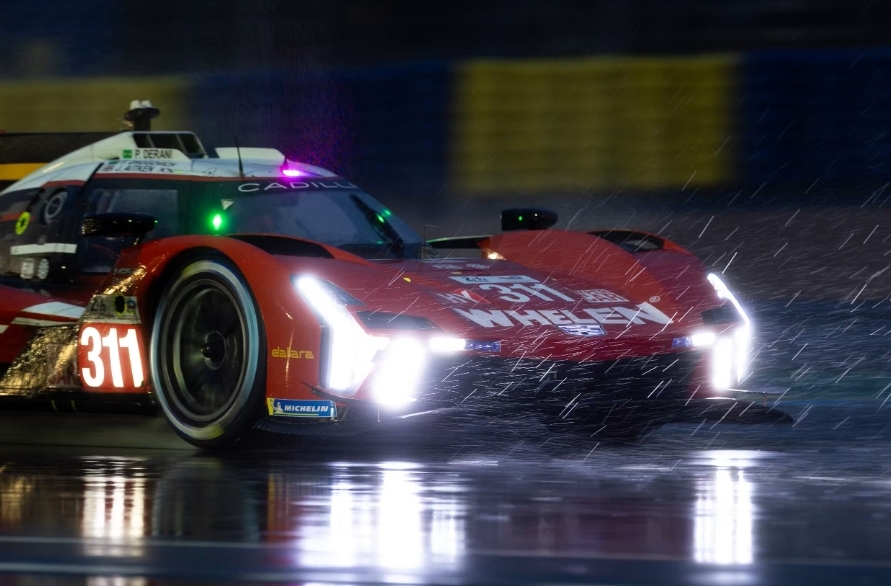
In June, the Pays de la Loire region has a habit of rewriting the weather forecast as it goes. It is capable of turning biblical at short notice. When it rains at Le Mans, it pours.
The Centenary race in 2023 showed how quickly things can change. Teams began the race in gorgeous sunshine, but as they approached the Porsche Curves just a few laps in, cars started spinning as the heavens opened.
If you want the most extraordinary example of what Le Mans weather can do, look no further than 1995. McLaren arrived as the underdog, with the F1 GTR going up against purpose-built prototype machinery. Rain fell for much of the race, and those tricky conditions acted as the great equaliser.
Delicate prototypes struggled in standing water. McLaren capitalised on this with their reliability and JJ Lehto’s fantastic overnight stint, maintaining his composure inside the #59 and bringing the team into contention. A 1–3–4–5 finish followed for McLaren on their very first Le Mans attempt.
It remains one of the sport’s most remarkable achievements, and it was the rain that made it possible.
The Night
For roughly six to seven hours, Le Mans drivers operate in darkness. The Circuit de la Sarthe is not the same as a floodlit night race in Bahrain or Singapore.
There are no stadium lights illuminating the Mulsanne Straight. There is no ambient glow. Just your headlights, the road, and the occasional blinding flash of a faster car bearing down on you from behind.
Navigating traffic in daylight is already a discipline, but at 2 a.m., with fatigue beginning to bite and your reference points dissolving into black, it becomes a different animal entirely.
Between 2:30 a.m. and 3:00 a.m. is considered the most dangerous stretch of the race, when the body is fighting hardest against consciousness. Yet the drivers press on, lap after lap, trusting muscle memory.
Human Endurance
Each car has a team of three drivers who switch out in stints. Modern regulations now cap each driver at 14 hours total in the car.
It sounds manageable until you factor in the mental load: extended stints, fragmented power naps in a motorhome while your teammates are on track, and then a return to a machine navigating traffic at 200 mph.
But it wasn’t always so carefully monitored. At the 1950 edition, Louis Rosier drove his Talbot-Lago for an astonishing 23 hours and 10 minutes, handing the wheel to his son only briefly.
Endurance racing has evolved enormously, but Rosier’s effort remains a testament to the sheer willpower that Le Mans demands.
Cars wouldn’t make it onto the start grid without the team in the garage. This means there is no rest for them either. Pit crews must perform at their peak at 4 a.m. just as they did at 4 p.m. One minor delay can cost minutes that never come back.
The Machine
Cars are not designed to run flat out for a full day. At Le Mans, they are pushed to their absolute limits.
The Mulsanne Straight still sees cars exceeding 200 mph on every lap, even with two chicanes having been added in 1990. The stress placed on engines, gearboxes, brakes, and tyres is enormous.
A single component failure can undo twelve months of preparation in an instant.
In 1990, Mark Blundell was at the wheel of his Nissan R90CK when a turbo failure left the engine stuck in full overboost. His engine was producing over 1,100 horsepower from a unit tuned for around 800.
Ignoring calls to pit, Blundell kept his foot in and manhandled the wildly oversteering car around the circuit, posting a pole lap more than six seconds faster than anyone else that weekend.
It is one of the most audacious laps in Le Mans history, born entirely of mechanical chaos and a driver with the ability to tame the beast.
The modern era has brought greater reliability to both Formula 1 and endurance racing. But the Circuit de la Sarthe will always bite those who let their guard slip.
2026
The 2026 edition of the 24 Hours of Le Mans is just under two weeks away.
The track is the same unforgiving combination of public roads and high-speed straights. The weather is still unpredictable. The night still comes. The cars still have to survive.
Every team on that grid knows what Le Mans costs. Most will have done the calculations — the strategy, the BoP implications, the tyre modelling, and the driver rotation plans. But that is only half the battle.
Some will have prepared for two years. Some will win. Most will not.
That’s the race.

