By Laura Juliana Flórez Alba
In December 2008, the global financial crisis forced Honda to abruptly pull the plug on their Formula 1 project. Left in the ashes were a dormant chassis and 700 jobs hanging in the balance. The clock was ticking to find a saviour before the grid line up in Melbourne.
Enter Ross Brawn. The mastermind behind Ferrari’s golden era, Brawn carried an aura of quiet, unshakeable authority. With buyers backing out, Brawn took the ultimate gamble. In a boardroom maneuver that became instant legend, he handed a Honda executive a single British pound to formalize a management buyout.
High profile suitors circled the dying team, most notably millionaire Richard Branson. He heavily flirted with a direct buyout but ultimately desisted. While Branson opted out of owning the team, he didn’t walk away entirely, his Virgin Group swooped in as the primary sponsor, their iconic branding adding a splash of red to the otherwise stark white cars.
With a lifeline in the form of a Mercedes engine, both drivers agreed to slashed salaries just to keep the dream alive. Brawn GP was born from thin air.
The loophole that broke the grid
Formula 1’s 2009 regulations were designed to slash downforce, forcing cars closer to promote overtaking. But Brawn’s engineers found a masterstroke in the gray areas, the double diffuser. This ingenious bodywork at the rear end of the car clawed back massive amounts of downforce, gluing the BGP 001 to the tarmac and allowing blistering cornering speeds that translated into unmatched straight line velocity.
When the white cars rolled out for winter testing at Silverstone and Catalunya, the paddock went from sympathetic to cautiously curious. By the season opener in Australia, Button and Barrichello locked out the front row and cruised to a 1-2 finish.
The rest of the grid cried foul. Rivals insisted the car was illegal, but the FIA cleared the double diffuser. As the old adage goes: the best way to become unpopular is to start winning, and Brawn GP was winning everything, with Button taking the checkered flag six of the first seven races.
Piranha Club politics
But Formula 1 is never just about what happens on the track. Behind the scenes, a political war threatened to tear the sport apart. Brawn GP found themselves in a bitter dispute with Bernie Ecclestone over unpaid money from the 2008 Honda days.
Meanwhile, a fierce battle over budget caps united the teams into FOTA (Formula One Teams Association), who threatened to launch a breakaway series if the FIA didn’t relent. In desperate need of cash to survive, Brawn broke ranks and signed an agreement to race in 2010. Ecclestone, in a classic power play, leaked this to other teams, leaving Brawn feeling like a traitor in the paddock.
Yet, an unexpected player came to be, Mercedes expressed serious interest in investing, setting the stage for a long term future if Brawn could survive the season.
Fractures, Fear and “Cambergate”
By mid-season, the fairytale began to crack. Once the European leg hit, rivals like Red Bull, spearheaded by a young, relentless Sebastian Vettel, hunted Brawn down. Button’s form dipped dramatically at Silverstone, and the pressure within the Brawn garage reached a boiling point. Barrichello, a veteran tired of playing second fiddle, began to openly question team decisions, feeling Button was being favored by the team.
This internal tension exploded at Monza in what became known as Cambergate. Bridgestone had set strict tire camber limits for safety reasons. Button obeyed the rules and sacrificed downforce; Barrichello pushed the limits, ran an illegal camber setup and took the victory.
The season was also darkened by a chilling reminder of the sport’s inherent danger. During qualifying in Hungary, a metal spring violently detached from Barrichello’s car, striking Ferrari’s Felipe Massa in the helmet at 270 km/h. The harrowing, near fatal crash cast a long shadow over the paddock and ultimately sparked upgrades in motorsport safety.
The miracle in Interlagos
The climax of the season for Brawn GP arrived in Brazil. The championship hung on a knife-edge. Barrichello started on pole in front of his adoring home crowd, while Button languished in 14th, and Vettel in 15th. It seemed destined that the title fight would drag on to the finale in Abu Dhabi. But true to the chaotic nature of the 2009 championship, the script flipped.
While Button unleashed a ferocious, fearless drive through the midfield to climb to 5th, Barrichello’s dream unraveled. Following a late pit stop and a subsequent puncture after a scrap with Lewis Hamilton, the driver’s title hopes evaporated. As Button crossed the line, the impossible was realized.
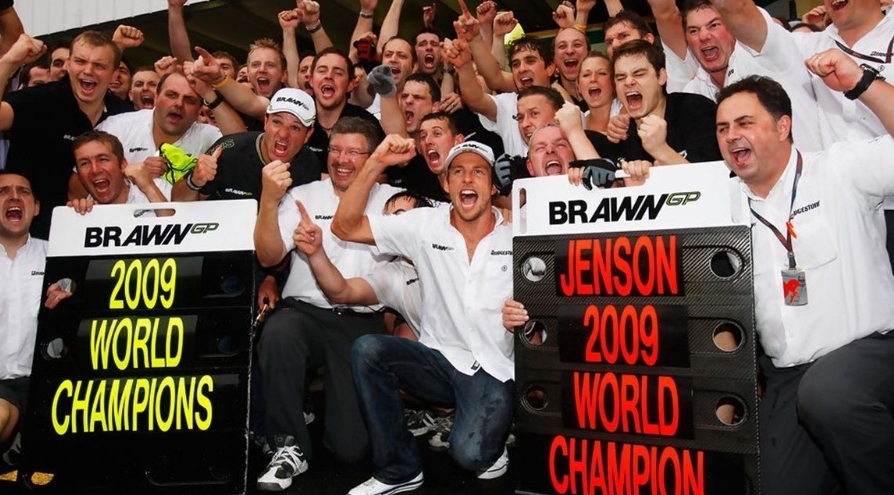
Brawn GP, a team bought for a coin, had conquered the world, becoming the first and only team to win both the Drivers and Constructors Championships in their debut year.
By November, Mercedes-Benz swooped in to purchase a 75.1% stake in the team. Brawn GP vanished as quickly as it had appeared, transforming back into a silver arrow, and leaving behind the greatest single-season myth in the history of Formula 1.
The One-Pound Fairytale: How Brawn GP hijacked Formula 1