By Cait Harkin
A retrospective on rain-soaked Grands Prix that reshaped championships, and why wet weather exposes character more than dry pace.
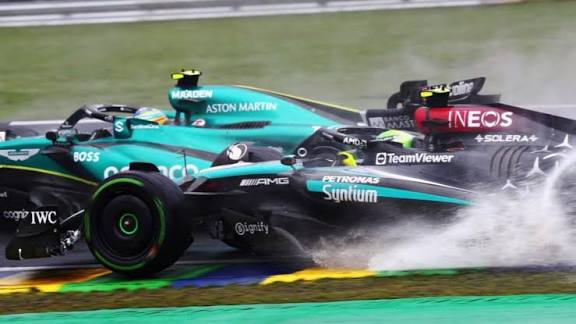
There is a tendency in Formula One to explain success through machinery. The fastest car wins, the strongest development programme prevails, and over a full season that is usually correct. But when rain arrives, any sense of logic goes out the window. Grip disappears, visibility drops, and instinct is the driving factor.
Wet races matter because they remove the ‘sure thing’. Braking points change from lap to lap. Parts of the circuit dry while others remain slippery. Drivers cannot rely purely on muscle memory. They have to interpret what the car is doing in real time and decide how much risk to accept. Some drivers really thrive in that environment. Others do not.
As the title hints, there are a few races which stand out in Grand Prix history because the rain did more than just create spectacle and damp spectators. It truly altered championships, and revealed character under pressure.
Brazil in 2008 remains one of the clearest examples. Felipe Massa won at Interlagos and, briefly, believed he had secured the world championship. Lewis Hamilton only needed fifth place to take the title, but a late shower complicated everything. Sebastian Vettel passed him with two laps remaining, dropping Hamilton to sixth. On the final lap Hamilton overtook Timo Glock, who was struggling on dry tyres as conditions worsened, at the final corner. That single position secured the championship by one point.
The moment is famous, but the composure behind it is more revealing. With the title slipping away and the track deteriorating, Hamilton stayed calm enough to recognise the opportunity when it appeared. It was an early sign of the emotional control that would define much of his career.
Monaco in 1996 showed a different side of wet racing. Heavy, relentless rain meant only three cars were classified at the finish. Olivier Panis won from fourteenth on the grid for Ligier, which remains the team’s final victory in Formula One. Panis succeeded because he avoided mistakes while others did not. Patience became a competitive advantage.
Canada in 2011 demonstrated how resilience can matter more than pace. The race lasted just over four hours because of rain delays and multiple safety car periods. Jenson Button collided with Lewis Hamilton, had a puncture after contact with Fernando Alonso, served a drive through penalty, and at one stage ran last. Many drivers would have chosen this moment to mentally check out. Button kept rebuilding his race as conditions evolved. On the final lap Sebastian Vettel slid wide while leading, and Button passed him to take victory. It remains one of the most remarkable recoveries in Formula One history.
Hungary in 2021 showed how rain can reshape a championship even when the winner is not a title contender. Wet conditions contributed to a chain reaction crash at the first corner triggered by Valtteri Bottas, which immediately eliminated several cars and heavily damaged Max Verstappen’s Red Bull. Lewis Hamilton was the main championship beneficiary in points terms despite losing the lead during a restart strategy error when he was the only driver to remain on intermediate tyres. Esteban Ocon went on to secure his first win for Alpine after holding off Sebastian Vettel late in the race. The momentum shift fed directly into the intensity of that season’s title fight.
What connects these races is exposure. Rain strips away layers of predictability that normally protect drivers. Engineers cannot model every variable when water is pooling unpredictably across the circuit.
That is why certain names repeatedly appear in discussions of wet weather excellence across eras. Ayrton Senna, Michael Schumacher, Lewis Hamilton, Max Verstappen, and Fernando Alonso all share an unusual confidence in unstable conditions. They show a comfortability, adapting instead of forcing control.
There is also a psychological dimension that becomes more visible in the rain. Mistakes carry greater consequences, which increases pressure. Drivers who remain mentally flexible recover quickly from small errors. Drivers who tense up often compound them.
Dry conditions show how fast a car can be. Rain shows how a driver thinks, reacts, and holds themselves together when certainty disappears. Championships can turn on those moments, but even when they do not, they reveal something more fundamental about the people inside the cockpit.
 WHEEL2WHEEL REPORTS