By Joshua Waite
It used to take minutes. Now it takes less time than reading this sentence. The evolution of the F1 pit stop is wilder than most people realise.
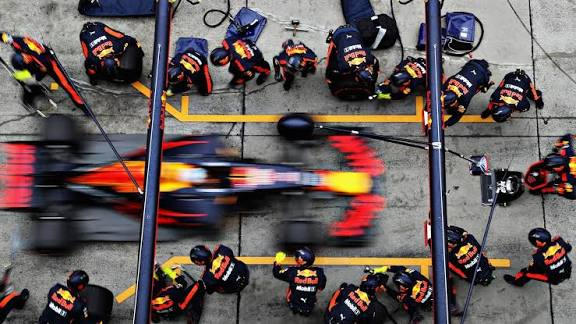
There is a moment during almost every Formula One race where fans find themselves leaning forward with intrigue, and it isn’t always when the lights go out, or even at a late safety car restart, but when a car dives into the pit lane. When you stop and think about it, what happens in those next few seconds is completely absurd. Twenty-plus people, moving in near-perfect synchrony, changing four tyres on a machine worth millions of pounds, in roughly the time it takes to blink twice. It is one of the most remarkable things in sport, and half the time it’s treated as background drama between the real action.
It Wasn’t Always Like This
Going back to the early days of the World Championship during the 1950s and into the 1960s, pit stops were a completely different proposition. Mechanics worked with hand tools, often taking over a minute to change tyres and refuel. There was no choreography, no split-second role assignments, and the whole ordeal looked more like a stressful trip to a garage forecourt than the military operation we see today. Drivers weren’t thinking about undercuts or tyre-windows; they just stopped when they had to. That was the extent of it.
The turbocharged 1980s changed the mindset though. Fuel-hungry, tyre-shredding cars made stops unavoidable, and once teams accepted that, the mindset shifted: if you have to stop anyway, you may as well get good at it. Roles became defined, and a team’s garage began operating more like a production line. The pit stop was no longer just a cost; it was a competitive tool. Get it right and you gain ground, get it wrong, and you lose a race you had no business losing.
When Strategy Became a Weapon
One of the most complete examples of a race won from the pits came at the 1998 Hungarian Grand Prix. Michael Schumacher was running second behind McLaren’s Mika Häkkinen when Ferrari switched him to an aggressive three-stop strategy. The plan was simple in theory and ruthless in execution: fit fresh tyres, reduce the fuel load, and ask Schumacher to produce a sequence of qualifying-level laps to build a gap large enough to make up for the extra stop. That’s exactly what the German legend delivered. When the final stops played out, he emerged ahead, winning the race without ever passing Häkkinen on track.
Refuelling, which ran from 1994 until the end of 2009, deepened this strategic complexity. The undercut, the overcut, the fuel-heavy opening stint, much of the modern tactical language was sharpened during this era. But the fuel rig imposed a limit on how quick a stop could be. However efficient the tyre change, the car could not be released until it was fuelled. When refuelling was banned for 2010, that constraint vanished. Tyre change speed became the defining variable within the stop itself, and the race to go properly fast began.
The Disasters
For every tactical masterclass, there’s a stop that still makes you wince. The 2013 German Grand Prix delivered one of the most uncomfortable moments of the modern pit lane era when Mark Webber was released by Red Bull with his right-rear wheel not properly secured. Seconds later, the tyre detached in the pit lane and struck a cameraman, who thankfully survived despite suffering broken ribs and a concussion as Webber briefly rejoined the track before retiring. The replays told the story in brutal detail: a breakdown in the pit stop signalling system, the car released before the wheel was fully fastened. One procedural lapse, and an afternoon’s racing for Red Bull ruined in an instant.
If individual disasters expose a single mistake, Ferrari’s recent history in the pit lane tells a broader, and much more painful story than any other constructor. In the late 2010s and early 2020s, Ferrari were rarely short of speed, but too often short of coordination. A hesitant tyre call here, a slow stop there, an unsafe release at the worst possible moment; the margins kept slipping away. It was not one dramatic collapse, but a series of small cracks, each one shaving away precious points and sending momentum and confidence south. In a sport that demands precision in every area, even hesitation carries a huge cost. That is why their turnaround last season, sealed with the DHL Fastest Pit Stop Award, meant more than stopwatch numbers. It felt like a team finally finding its rhythm again.
Sub-Two Seconds: Where Did That Even Come From?
Against that backdrop, what Red Bull have achieved at their peak borders on the surreal. Consistency is the word that immediately comes to mind, seven consecutive DHL Fastest Pit Stop Awards from 2018 to 2024 tells its own story, but it is the 1.82-second stop at the Brazilian Grand Prix in 2019 that still stops you in your tracks, a world record that stood until 2023.
For context, the average human reaction time to a visual cue sits at around 0.25 seconds. In roughly seven blinks, a car arrives, is lifted, stripped of four tyres, fitted with four more, dropped and fired back on track. It barely feels real when you watch it live.
Reaching that level demanded the same obsession with marginal-gains more commonly associated with elite cycling. Slow-motion footage studied frame by frame. Bespoke pneumatic guns calibrated to the precise torque required. Highly drilled crews where every movement is rehearsed to exhaustion. On paper, it sounds excessive. In practice, it produced something that almost defies belief. It should not be possible. And yet, somehow, it is.
What Comes Next?
Can teams go meaningfully faster than 1.82 seconds, or even McLaren’s 2023 record of 1.8? Opinions are split. Some believe advances in wheel-nut technology could push times lower still. Others argue that human reaction time creates a hard floor no amount of training can break through. The FIA has already begun exploring standardised wheel-nut systems that would level the playing field between well-funded teams and smaller operations who can’t match the drilling regimes of the top outfits. A 0.3-second advantage in the pit lane, multiplied across a race strategy, is serious time.
What most fans push back on at the moment is the idea that slowing pit stops down would make the racing better. The pit stop is one of the few moments in modern Formula One where the outcome is genuinely unpredictable, where a team can lose a race through a single mistake, or steal one through flawless execution. That tension is what makes it worth watching. The sport already has enough variables being smoothed away in the name of fairness. The pit stop, at its chaotic, blink-and-you’ll-miss-it best, feels like one worth protecting.
 WHEEL2WHEEL REPORTS