By Emily Nery
For years, the Brazilian Grand Prix at Autódromo José Carlos Pace started earlier in the afternoon, usually around 1:00 PM or 2:00 PM local time. The entire race ran in daylight. From the start to the chequered flag, whatever São Paulo decided to throw at the track played out under natural light. At Interlagos track, the weather rarely stays quiet.
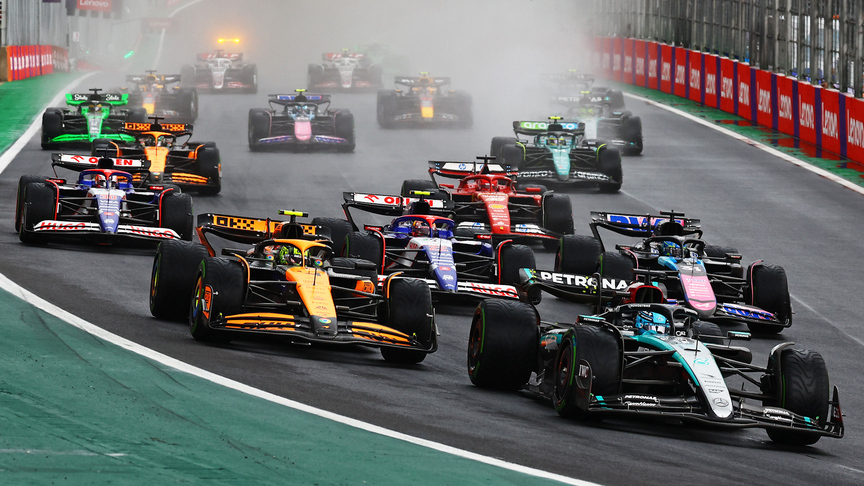
The circuit sits on elevated ground in the southern part of the city, in the middle of Guarapiranga and Billings reservoirs. Moist air rises from the water, mixes with urban heat and unstable air currents, and the result is familiar to anyone who has watched a race there. Clouds build quickly. One part of the circuit can be soaked while another remains dry. Visibility can change in a matter of minutes.
Earlier start times meant the race unfolded through a full afternoon cycle. Temperatures could rise during the opening laps, increasing tyre wear and putting strain on cooling systems. Then the sky would darken, humidity would climb and grip levels would shift again. Teams had to react constantly. Interlagos rarely gave them a stable reference point.
The layout only makes that harder. The elevation changes unsettle the car under braking. The long left-hander at Turn 3 loads the tyres heavily at the start of each lap. Small differences in track temperature or cloud cover can change balance quickly. At this circuit, light and weather are not background details. They affect how the car feels.
Moments like Ayrton Senna’s 1991 victory, when he fought home despite a gearbox failure that left him stuck in sixth gear, underline how exposed Interlagos can be. Small problems grow quickly. Physical effort rises. The circuit demands concentration from start to finish.
Over the past decade, the start time has moved closer to 3:00 PM local time, reflecting the global broadcast priorities of Formula One. It is still a daytime race, but the final stages now edge toward early evening. Temperatures tend to fall rather than rise. Shadows stretch across the track. Podium ceremonies often take place under floodlights. The shift’s subtle, but it changes the feel of the event.
Interlagos has always produced weather dramas. The 2003 race was stopped in heavy rain. In 2016, downpours led to multiple red flags. In 2023, qualifying was effectively decided when a storm hit just as Q3 began, darkening the sky and forcing a red flag before most drivers could complete their laps. However, the unpredictability has not disappeared.
Earlier races belongs entirely to one stretch of afternoon light. Now the event moves gradually toward dusk. The air cools. The light fades. Artificial lighting frames the closing scenes.
The track is still volatile. The reservoir is still there. The storms still roll in. But the Brazilian Grand Prix no longer lives fully in the middle of the afternoon. It now transitions into evening, and that small shift has quietly altered the rhythm of Interlagos.
 WHEEL2WHEEL REPORTS