Pioneering Safety and Healthcare on the Fastest Stage – By Kate Dowding
Formula 1 has transformed from a sport where fatalities were common to one where drivers regularly survive crashes at 200+ mph. This is thanks to a ‘safety first’ approach, driven by the sport’s relentless pursuit of safety and medical innovation.
Over the decades, Formula 1 has acted as a powerful catalyst for innovations that have improved driver safety, enhanced medical responses during races, and even impacted medical practices outside the world of racing.
The Early Days: A Need for Change
In the early years of Formula 1, medical provisions were rudimentary at best. Accidents often proved fatal due to inadequate safety measures and slow medical intervention. The tragic losses of drivers such as Ayrton Senna and Roland Ratzenberger in the 1990s marked a turning point, compelling the sport’s governing bodies to prioritise medical preparedness and technological advancement.
Trackside Medical Response
Sir Jackie Stewart campaigned heavily for safety, forcing changes in the 1960s and 70s, including better barriers and on-site medical care.
Today, every Formula 1 circuit boasts state-of-the-art medical facilities. That is thanks in no small part to Professor Sid Watkins, the FIA Medical Delegate for over 25 years (1978-2004). He fundamentally changed the medical response in Formula 1, pushing for specialist medical teams and rescue medivac helicopters. He commissioned the medical car after the 1978 Italian Grand Prix, which saw a pile-up shortly after the start claim the life of driver Ronnie Peterson.
The introduction of the Medical Car, a high-performance vehicle equipped with advanced life-saving equipment and manned by skilled medics, ensures immediate response to incidents on track. It follows the pack on the first lap of the race, as this is the most dangerous part of the race, to guarantee rapid response – the medical team is now able to reach an accident site within seconds, a far cry from the response times of the past.
Biometric Monitoring
Drivers wear biometric gloves containing sensors that transmit real-time health data on the driver’s heart rate, pulse oximetry and breathing rate to the medical team. If an impact exceeds certain thresholds such as 15G horizontally or 25G vertically, this is detected and a medical car is dispatched immediately. Formula 1 cars now have a flashing blue light that indicates if a car has experienced a significant G-force impact, alerting rescuers to check for injuries.
Fire-Resistant Gear (Nomex) and Helmet Technology
Modern racing suits, underwear, balaclavas and gloves must withstand temperatures of 800oC for 12 seconds, minimising burns. This was key in protecting Romain Grosjean in his 2020 crash, although this also showed where improvements still needed to be made, e.g. around the driver’s wrists and hands.
Helmets are made from carbon fibre, Kevlar, and include a Zylon strip to prevent penetration.
Innovative Safety Devices
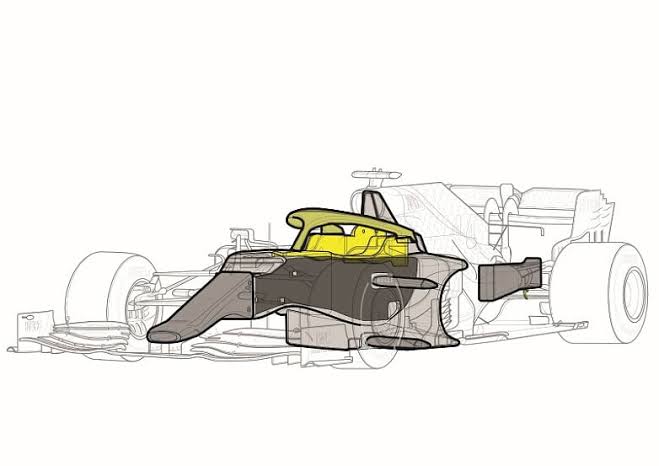
Since the 1980s, the cockpit has been built as a nearly indestructible carbon fibre ‘survival cell’, keeping the driver safe even if the rest of the car is damaged. The development of the HANS (Head and Neck Support) device revolutionised driver safety by significantly reducing the risk of head and neck injuries during high-impact crashes. Similarly, the Halo cockpit protection system – a titanium bar designed to protect the driver’s head – introduced in 2018, has already saved lives by shielding drivers from flying debris and direct impacts. 2025 saw the introduction of driver cooling kit, which is mandatory in extreme heat to prevent drivers overheating.
Impact Beyond the Racetrack
Many medical innovations pioneered in Formula 1 have found their way into wider medical practice. For example, advances in rapid trauma response, extraction techniques, and the use of carbon fibre stretchers have influenced emergency care around the world. The collaboration between motorsport engineers and medical professionals continues to push the boundaries of what is possible in critical care environments.
The Future of Medical Innovation in F1
The 2026 regulations continues the ‘safety first’ evolution with several new requirements, including stronger roll hoops, which must now withstand 23% more load, ERS safety lights, and a two-stage nose design mitigating risks during secondary impacts.
As Formula 1 evolves, so too will its medical standards. Emerging technologies such as artificial intelligence, advanced biometrics, and portable scanning equipment promise to further enhance safety. The ongoing commitment to research and development ensures that Formula 1 will remain at the forefront of medical innovation, benefiting not only its own community but society at large.
In essence, Formula 1’s legacy extends well beyond the chequered flag, driving progress in both motorsport safety and global healthcare innovation.
 WHEEL2WHEEL REPORTS