By Joe Murphy
Formula 1 (F1) has long been criticised for its environmental impact. The sport’s high-energy, high-performance nature results in significant greenhouse gas emissions, primarily from the combustion of fossil fuels in the cars’ engines. However, in recent years, F1 has made a concerted effort to reduce its carbon footprint and become a more sustainable sport.
One of the key areas of focus for F1’s sustainability push is the development of more efficient power units. The current generation of F1 engines, introduced in 2014, are turbocharged hybrid power units that combine a 1.6-litre internal combustion engine with an electric motor. These power units have been shown to be significantly more fuel-efficient than their predecessors, with a 30% reduction in fuel consumption compared to the previous generation of engines.
In addition to improving engine efficiency, F1 has also implemented a number of measures to reduce emissions from other areas of the sport. For example, teams are now required to use more sustainable fuels, such as biofuels, and to reduce energy consumption in their factories and facilities. The sport has also introduced a number of initiatives aimed at reducing waste and promoting recycling, such as the F1 Recycling Scheme, which encourages teams to recycle and reuse materials wherever possible.
F1’s sustainability efforts are not limited to on-track activities. The sport has also launched a number of initiatives aimed at promoting sustainability and reducing environmental impact off-track. For example, the F1 in Schools programme, which aims to educate young people about the principles of sustainability and encourage them to pursue careers in STEM fields.
The science behind F1’s sustainability efforts is complex and multifaceted. From a life cycle assessment perspective, the sport’s environmental impact can be broken down into several key areas, including fuel production and combustion, energy consumption, and waste generation. By targeting these areas, F1 can reduce its overall carbon footprint and become a more sustainable sport.
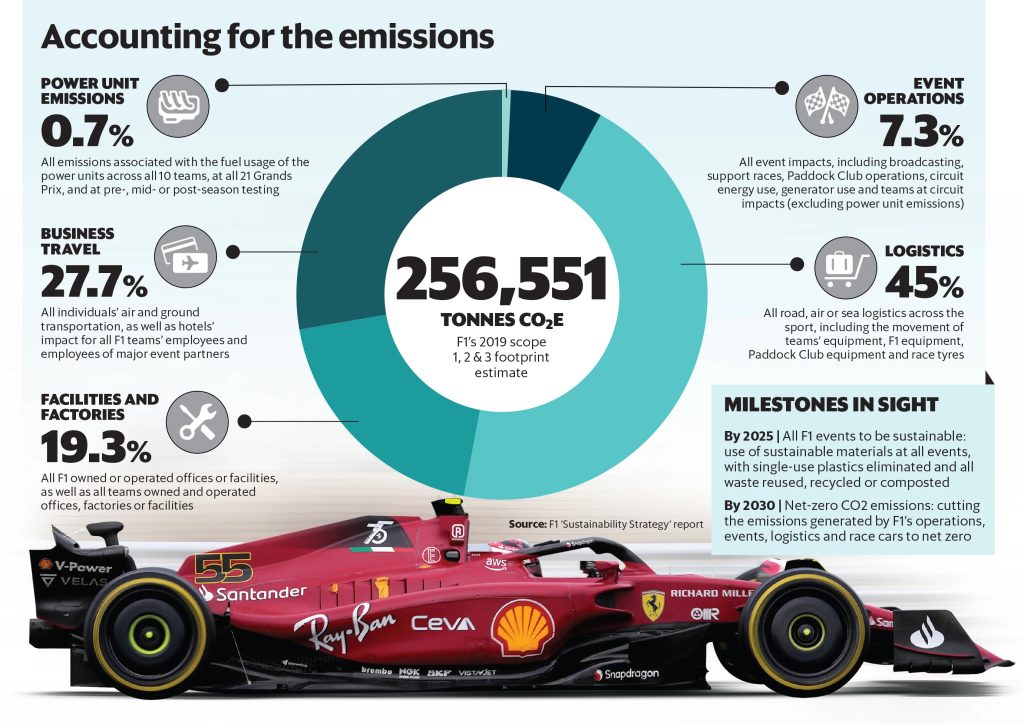
One of the key metrics used to measure F1’s sustainability is the sport’s carbon footprint, which is calculated using a life cycle assessment approach. According to F1’s own estimates, the sport’s carbon footprint is approximately 256,000 tonnes of CO2e (carbon dioxide equivalent) per year. This is roughly equivalent to the annual emissions of a small city.
To put this into perspective, a typical F1 car generates around 1.5 tonnes of CO2e per race weekend, with the majority of these emissions coming from the combustion of fossil fuels in the engine. However, it’s worth noting that F1’s carbon footprint is relatively small compared to other major sports, such as football or basketball.
Looking to the future, F1 has set ambitious targets to reduce its carbon footprint and become a more sustainable sport. The sport aims to be net zero carbon by 2030, and has introduced a number of initiatives aimed at achieving this goal. These include the development of more efficient power units, the use of sustainable fuels, and the implementation of a number of energy-saving measures across the sport.
F1’s sustainability push therefore is a complex and multifaceted effort that involves a range of scientific and technological innovations. While there is still much work to be done, the sport has made significant progress in recent years and is well on track to achieving its sustainability goals. By continuing to innovate and push the boundaries of what is possible, F1 can become a truly sustainable sport that inspires and educates fans around the world.
 WHEEL2WHEEL REPORTS