By Rukanah Mogra
There’s a romanticism attached to Formula 1’s turbo era that refuses to fade.
Mention qualifying boost and eyes light up. Whisper “1,000 horsepower” and nostalgia kicks in. Grainy footage of flames spitting from exhausts circulates like sacred scripture. It was louder. Faster. Wilder.
It was also, by any rational metric, terrifying.
When Renault introduced its 1.5-litre turbocharged V6 in 1977, much of the paddock scoffed. The RS01 earned the nickname “the yellow teapot” for its habit of expiring in smoke. But within a few seasons, scepticism gave way to imitation. By the mid-1980s, naturally aspirated engines were being outgunned and boost pressure had become Formula 1’s defining obsession.
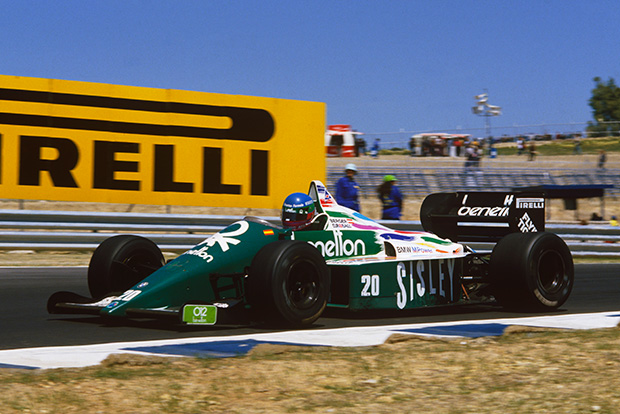
In race trim, turbo cars were already producing somewhere between 850 and 1,000 bhp. In qualifying, the numbers escalated into folklore. BMW’s M12/13 inline-four – run most famously by Brabham – is widely believed to have exceeded 1,200 bhp in short qualifying bursts, with some estimates stretching towards 1,400. Period dynos struggled to measure the true upper limit; many figures were extrapolated. Whether it was 1,200 or 1,350, the experience for the driver was the same: violent acceleration delivered in one overwhelming surge.
And crucially, it was unpredictable.
Teams would dial boost pressures up dramatically for qualifying, accepting that engine lifespan would shrink accordingly. These units were expected to survive only a handful of flat-out laps. Sometimes they didn’t manage that. Failures were rarely polite mechanical fade-outs; they were abrupt. One moment full boost, the next a plume of smoke and an instant loss of power at well over 300 km/h.
Then there was turbo lag – the era’s most treacherous signature. Drivers would squeeze the throttle, wait a heartbeat that felt far longer than it was, and then feel the boost arrive all at once. The needle on the boost gauge would flick right, the rear tyres would light up, and the steering would go light in the hands. Mid-corner, that surge could snap the car sideways without warning. There was no traction control, no torque mapping smoothing delivery by the millisecond. Managing throttle application wasn’t refinement; it was damage limitation.
The circuits amplified the jeopardy. The pre-modern layouts of Hockenheimring and Circuit de Spa-Francorchamps featured vast forest straights taken flat with comparatively modest run-off. At Autodromo Nazionale Monza, slipstreaming at 330 km/h was routine. Barriers felt closer. Margins were thinner.
The psychological strain is often lost beneath the horsepower figures. Fear in Formula 1 is rarely theatrical; it is procedural. It is the calculation before committing to Eau Rouge knowing the boost might spike at compression. It is balancing strict fuel limits – introduced in 1984 and capped at 150 litres by 1988 – while still racing at full intensity. Mechanical sympathy and outright pace were in constant conflict.
Drivers from the era speak about it without myth-making. Nelson Piquet described qualifying engines as “bombs” – not because explosion was guaranteed, but because they were pushed to the brink of mechanical survivability. Ayrton Senna, extracting extraordinary laps from the turbocharged Lotus F1 Team in the mid-1980s, spoke about operating beyond conscious thought. It sounded mystical. In truth, it was extreme concentration under extreme risk.
It is tempting to frame the turbo era as Formula 1’s reckless adolescence – an age of excess eventually curtailed by regulation when turbos were banned after 1988. But that narrative undersells the discipline involved. These were not cowboys wrestling monsters. They were elite drivers applying precision inputs to machinery that punished imprecision instantly.
Modern Formula 1 is faster in many measurable ways and infinitely more sophisticated. Data flows in real time. Power delivery is mapped with surgical accuracy. The margins are still fine, but the volatility is different.
The turbo era distilled the sport to something more primal: boost versus bravery, engineering ambition versus mechanical fragility.
Behind those closed helmets were not fearless men, but acutely aware ones. They felt the vibration through the chassis, watched the boost needle climb, and understood exactly what was at stake. Then they committed anyway.
That is why the turbo era endures – not merely for the numbers attached to it, but for the resilience it demanded. It wasn’t just about going faster. It was about surviving the attempt.
 WHEEL2WHEEL REPORTS