By Joe Murphy
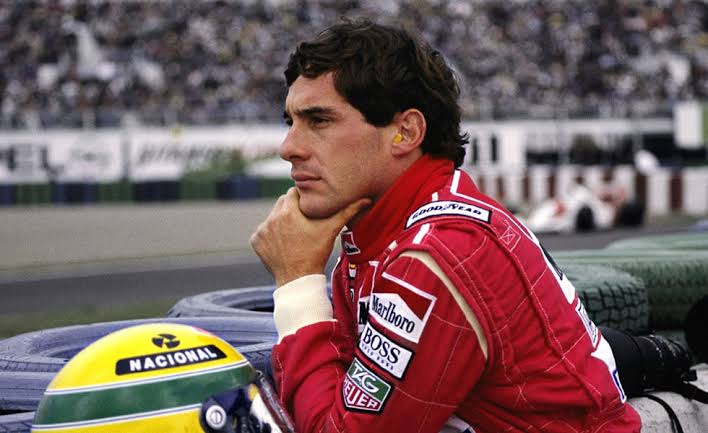
“Being second, is to be first of the ones who lose…”
Having started this website in March earlier this year, I always wanted to write a piece on a man who I regard to be the greatest talent motorsport has ever seen. The recent release of the Schumacher film on Netflix has only strengthened my desire to do this piece and now is as good a time as any. Speaking of the German, I am sure a piece on him will follow in due course.
Lewis Hamilton and Schumacher himself may have more world championships than Senna. Other drivers like Kimi Raikkonen and Rubens Barrichello may have more races under their respective belts than the Brazilian too. However, despite having life cut short by a tragic accident at Imola, the discussion for the ‘greatest of all time’ continues to throw up Senna’s name to this day.
On March 21st, 1960, Ayrton Senna da Silva was born into a wealthy Brazilian family. The passion for Formula 1 was embedded just four years later with the purchase of his first go-kart by his father. As per sources close to the family, Senna, through his youth, used to watch the F1 action religiously every weekend and used to literally shake at the prospect of one day, joining some of these racers on the grid.
Despite playing around in his kart during his schooling, it wasn’t until he turned thirteen that he raced competitively for the first time. Unsurprisingly, he won immediately. Some people argue that people are born with destiny to do certain things. It was clear Ayrton Senna was born to race. At just 21 years of age, Senna started racing single seater karts in the UK and in the subsequent three years, managed to win an astounding five Championships. The sacrifice to make it to Formula 1 was evident in the fact he divorced his young wife for a shot at a future in the sport. In 1984, he made his debut with Toleman Racing Team. He first caught the eye in Monte Carlo that year, finishing second only to Alain Prost’s McLaren. A new star was born in Formula 1. The rest, as they say, is history.
He would go on to win six times in the principality. This came, primarily, from his relentless pushing of both himself and the car. For this reason, he made the jump to Lotus by buying out his own Tolenman contract a year later he signed. This ambition paid dividends as he claimed 16 pole positions and six race wins. in 1988, it was now McLaren’s turn to house the Brazilian genius. These six seasons were truly dominant for the British Constructor as the team won the majority of races over this period. In an epic battle with Prost over the duration of these years, Senna managed to win 35 races which yielded a resultant three world championships. As a modern F1 fan, it is sometimes easy to forget just how much the Formula 1 calendar of today, has grown since then.

This battle Senna had with Prost is iconic in so many ways. There is a reason why the Verstappen v Hamilton duel is being compared to this very rivalry. 1989 and 1990 saw the now infamous Suzuka incidents which benefitted Prost in the former and Senna in the latter to respective world championship wins. It wasn’t until 1991 where Senna really showed his dominance in the sport, with not just some of his greatest performances personally, but some of the greatest performances in the history of the sport. In 1994, he moved to Williams for what would be his final season in motorsport.
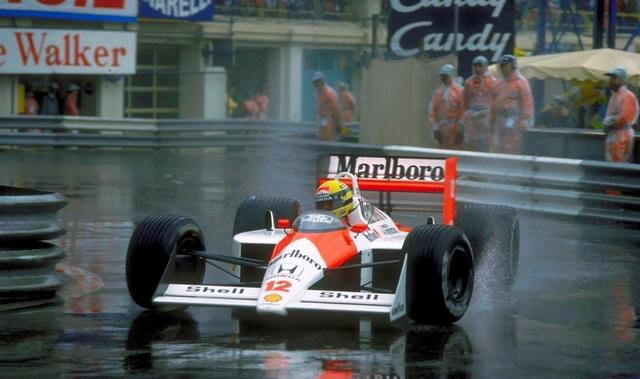
Senna is perhaps many fans’ favourite driver of all time. He inspired future world champions such as Lewis Hamilton to become what he is today. The figure he cut was one of a powerful, physical aura, who was passionate and determined to win. These traits applied to his driving, but not exclusively. It was evident in other aspects of his life too. Nothing epitomises this more, arguably, than his “lap of the gods” in Monaco. This clip raises the hairs on my arms with every viewing and is almost hypnotic in it’s enchanting nature. Commentators describe Senna as being a genius, but it almost extends further than that. He drove as if he were a man possessed, something the Brazilian admitted when he suggested he felt like a “passenger” during 1988 qualifying at the street circuit. This extended to all weather conditions too. He took risks in wet conditions that no other driver dared to do. As a result of his mastery in adverse weather led to his being christened as the “Rain Man”.
Despite the fear of going too far and losing control, Ayrton Senna never stopped pushing and exploring the boundaries of the cars he raced in and tracks he raced at. This obsession with pushing to find more and more pace and performances would ultimately be his downfall. On May 1st, 1994, Senna was leading the San Marino Grand Prix from a young yet pacey Michael Schumacher. His Williams his the concrete wall through Tamburello corner at an approximate 190 mph, and just like that, he was gone. It didn’t seem real to fans or drivers alike, with the race even restarting as Senna was air-lifted to hospital, under the impression the Brazilian has only suffered minor injuries and the expectation that he would fully recover. He never did and aged only 34, his life was over.
“Every time I push, I find something more, again and again. But there is a contradiction. The same moment that you become the fastest, you are enormously fragile. Because in a split second, it can be gone. All of it.“
Senna remains an icon in Brazil today, perhaps immortalised by his death. His fortune found its way to help underprivileged children in his homeland, all $400 million of it. It is certainly a founded argument to claim that Brazil had never mourned for someone like Senna before, and perhaps, never will again. People lined the streets to pay respects and remember a man who was simply; an icon.

How many more world championships he would have won, is merely speculation now. The one thing that is not up for debate, however, is the true genius of Ayrton Senna. That is why he is many people’s number one choice, when choosing the greatest racing driver to have ever lived.
 WHEEL2WHEEL REPORTS
One thought on “Wheel2Wheel Reports – An Ayrton Senna Retrospective”